What Nobody Tells You About Your First Dispersed Camping Trip
What Nobody Tells You About Your First Dispersed Camping Trip
The photos you see online show the fire, the stars, the coffee cup at sunrise with mountains in the background. Nobody posts the bathroom situation.
That’s the gap I want to close here.
Dispersed camping — camping on national forest, BLM, and public land without a designated site, no fees, no reservations — is the best kept secret in the American outdoors. But there are things that don’t come up until you’re already out there, usually at the worst possible moment. Let’s talk about them before you go.
The Bathroom. Let’s Just Start There.
This is the number one unspoken reality of dispersed camping and I’m going to say what everyone is thinking.
You pull into a pristine clearing in the national forest. Trees, silence, clean air, the whole thing. And then you walk twenty feet into the woods and find toilet paper behind every tree. Baby wipes. Evidence. A reminder that a hundred people camped here before you and a percentage of them did not think this through.
It is absolutely disgusting. And it is entirely preventable.
Here is what we do and what you should do:
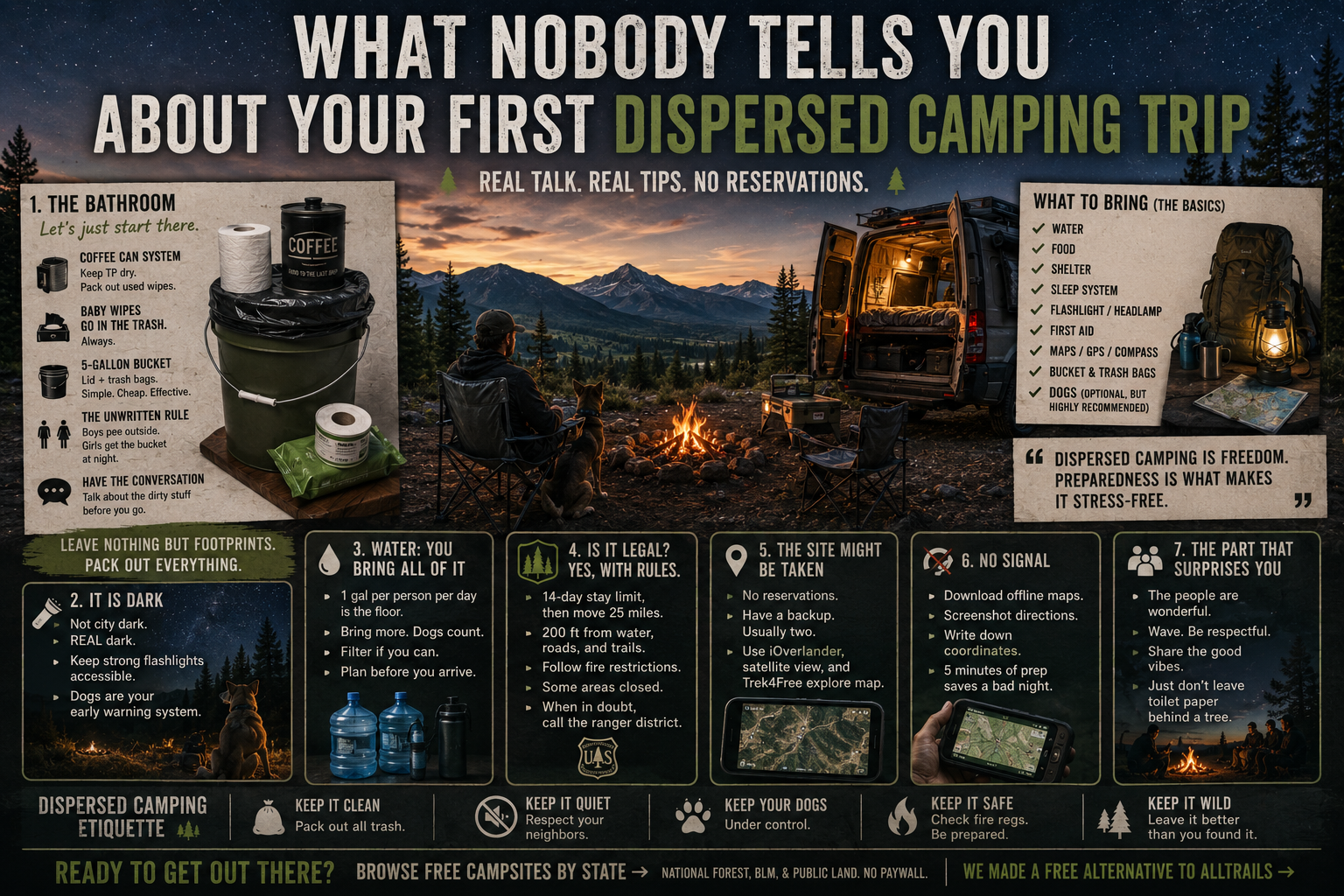
The coffee can. I keep a repurposed coffee can as my dry toilet paper holder. Lid on, stays dry, lives in the camping kit. Add a small bag for used wipes and you have a complete system that costs nothing.
Baby wipes go in the trash. Always. I don’t care what the package says. Flushable wipes are not flushable. They clog septic pumps, they clog RV dump stations, and they do not decompose quickly in the ground. If you’re using baby wipes in the backcountry — and you will use baby wipes in the backcountry — they go into a zip-lock bag and then into your trash bag and then out of the forest with you. No exceptions.
The five-gallon bucket. For serious situations — and there will be serious situations — we use a five-gallon bucket with a lid and a stack of trash bags layered inside each other. The concept: bag goes in, you use it, you seal the inner bag, a fresh bag is already in place underneath. You are never dealing with a contaminated bucket. You are dealing with sealed bags that go in the trash.
You can add kitty litter if you want — it controls odor. Honestly, a well-sealed trash bag and a tight lid handles it. I’m not buying a $150 cassette toilet that needs to be emptied and cleaned and stored and hauled around. A bucket and trash bags costs four dollars and takes fifteen minutes to set up. That’s fifteen dollars I’d rather spend on gas to get somewhere worth camping.
The unwritten rule. Boys pee outside. Girls get the bucket when it’s dark or they don’t feel like navigating the woods at 2am. This is not a negotiation. This is just how it works.
The briefing. If you are taking someone from the city on their first dispersed camping trip — a partner, a friend, anyone who has not done this before — you must have the bathroom conversation before you leave. Not when you get there. Not when it’s dark and there’s no signal and the moment has arrived. Before you go. Talk about the dirty stuff. It is not a romantic conversation but it is a necessary one and every couple that camps together has eventually had it. Better to have it in the driveway.
It Is Dark
Not city dark. Not suburb dark. Not even rural-highway dark.
Dispersed camping dark means when the fire goes out and you don’t have a light, you cannot see your hand in front of your face. This surprises people. It shouldn’t, but it does.
We keep strong flashlights — the kind that can illuminate fifty yards — accessible at all times. Not in the bottom of a bag. In a door pocket. On a camp table. Somewhere you can put your hand on it in under five seconds without thinking.
The dark also handles the security question, which comes up: is it safe out there? Our experience, over years of dispersed camping across a dozen states, is that the people out there are almost uniformly fine. Better than fine — interesting, self-sufficient, minded their own business. The occasional oddity exists but it exists in parking lots and neighborhoods too.
Our alarm system is the dogs. A dog that goes quiet and alert at 2am is telling you something worth knowing about. A dog that sleeps through the night is telling you something too.
We also keep the camp organized so that if we needed to leave in fifteen minutes, we could. Not because we expect to need to. Because knowing we can makes the sleep better.
Water: You Bring All of It
There is no spigot. There is no stream you can trust without a filter. There is no option to run to the gas station.
For a two-night trip for two people and two dogs, we bring more water than we think we need, and we still sometimes run lower than we’d like. A gallon per person per day is the floor. Two gallons is comfort. The dogs count.
A Sawyer squeeze filter or a Katadyn BeFree lives in the kit — if there’s running water nearby, we can supplement. If there isn’t, we work with what we carried. Either way, we know before we arrive whether there’s a water source within reasonable distance.
”Is This Actually Legal?”
Yes, with rules.
National forest and BLM land allows dispersed camping throughout, with some exceptions. The standard rules: 14-day stay limit in one location, then you move at least 25 miles. No camping within 200 feet of a water source. Campfire rules change with fire danger — check current restrictions before you light anything.
Some areas have designated dispersed camping zones and some areas are closed to camping — these are posted at trailheads and on the forest service website. When in doubt, the ranger district office will tell you exactly what’s allowed where. They’re helpful. Call them.
Trek4Free’s free camping map aggregates dispersed camping locations on national forest and BLM land across the country. It’s a starting point — conditions change, access roads close, so verify current status before you commit to a long drive.
The Site Might Be Taken
There are no reservations. If you drive three hours to a spot you found on a map and someone else is already there, they are allowed to be there, and you need a backup plan.
We always have a backup. Usually two backups. Before a trip we identify three possible sites in the general area so that if the first one doesn’t work, we’re not driving home. Google Maps satellite view and the Trek4Free explore map together give you enough to work with.
No Signal
Your phone will work until it doesn’t, and in the places worth dispersed camping, it often doesn’t. Download offline maps before you leave — Gaia GPS has a free tier with enough functionality for trip planning. Screenshot your directions. Write down the coordinates.
The person who drives thirty miles down a forest road without knowing how to get back out without a phone signal is the same person who will be calling it a disaster by nightfall. Five minutes of preparation prevents that entirely.
The Part That Actually Surprises You
Here is what nobody tells you about dispersed camping that is actually worth knowing:
The people are wonderful.
Not all of them — see: bathroom situation above — but the general population of people who find their way to a dispersed site on a forest road twenty miles from a gas station trends heavily toward people who know what they’re doing, respect where they are, and want to be left alone in a good way. Neighbors who wave and keep to themselves. People with dogs who understand that your dogs are fine. Occasional conversations at dusk that turn into genuinely interesting exchanges.
We have met more interesting people at dispersed campsites than at any paid campground anywhere. The barrier to entry — the fact that you have to figure it out yourself and drive past the easy options — filters for a certain kind of person. You’re going to like them.
Just don’t leave toilet paper behind a tree. That one’s on you.
New to dispersed camping? Browse free campsites by state — national forest, BLM, and public land, no paywall. Every listing links to nearby trails, swimming holes, and outdoor spots within 8 miles. Read why we built it: we made a free alternative to AllTrails →