We Already Paid for These Campgrounds. Here's How to Use Them for Free.
We Already Paid for These Campgrounds. Here’s How to Use Them for Free.
Let’s do the math on a single night at a national park campground.
Federal income taxes: you’ve been paying those your whole working life, and a portion of that money funds the National Park Service, the Forest Service, and the Bureau of Land Management. That’s your money. That’s your land.
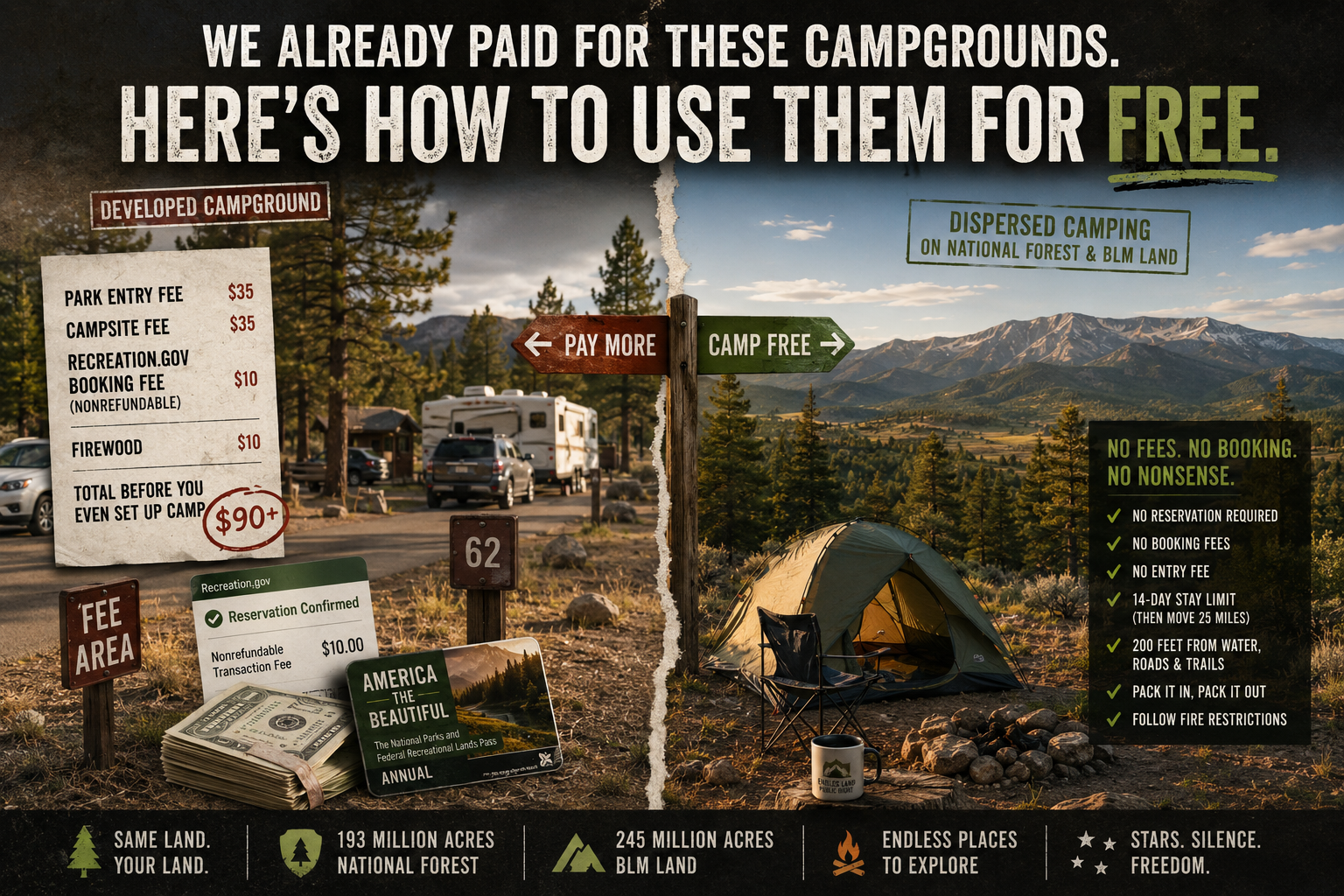
Park entry fee: $35 per vehicle. The America the Beautiful annual pass is $80 and covers most federal sites for a year, which is the better deal, but it’s still $80.
Campsite fee: $25–$45 per night at most developed national park campgrounds.
Recreation.gov booking fee: $10, nonrefundable, charged the moment you click confirm. Cancel your trip? You lose it. Plans change? You lose it. Weather closes the road? You lose it. The land is yours but the booking fee is not.
So we’re at $35 entry + $35 campsite + $10 booking fee before you’ve bought a single bag of firewood — which is another $10 at the campground store, because you can’t bring your own into most parks.
I am not against paying for things. I understand maintenance costs and staffing and trail repair. I understand that public land management is genuinely expensive and that someone has to pay for it.
What I don’t understand is a nonrefundable transaction fee on a public resource that my taxes already fund. That one is just a cash grab.
The Camp Hosts in Cloudcroft
I was camped in a paid national forest campground outside Cloudcroft, New Mexico — one of the cooler, greener mountain towns in the Lincoln National Forest, the kind of place that catches you off guard if you think New Mexico is all desert.
The campground had camp hosts. A couple, working their absolute tails off — cleaning the bathrooms, managing the sites, handling the endless small emergencies that come with a full campground. It looked like a full-time job. Two full-time jobs, for two people who were probably getting their site comped and a small stipend in return for what amounted to running a public recreation facility.
They seemed grumpy. Miserable, honestly. The campground was overflowing, the bathrooms were a constant battle, and guests kept arriving. I watched this and thought: someone is making money off this arrangement, and it is not these two people.
Then there were the showers. One set of showers, down the road from the campground — $7 per person, per use, on top of the nightly fee we’d already paid to be there.
In the entire time we were there, I never saw a single government employee. No ranger. No Forest Service uniform. No one whose paycheck was accounting for any portion of what we’d paid.
Then the federal government shut down. And something strange happened: the gates were open. No entry fees. No one checking passes. And the outdoor areas ran just fine. Maybe even a little smoother — without the machinery humming, the wilderness just was what it was.
I love our park rangers. I mean that genuinely. I want the black bears protected from the people who think feeding them is a photo opportunity. I want trails maintained and wilderness boundaries enforced. Rangers do necessary, hard, underappreciated work.
But there’s also something true about bureaucracy adding friction to the thing it’s supposed to protect. Something true about a system that runs on unpaid camp hosts while charging campers extra for a shower.
The Lottery That Replaced the Open Gate
It’s gotten worse since then.
Try to visit a popular national park now and you need a timed entry reservation — which means you need the app, which means you need cell service, which means you need to have planned days or weeks out, which means if you didn’t book before 8:30am on the day reservations opened, you’re not getting in.
My daughter figured this out for us. She’s a wizard with her phone — she knew exactly which day spots opened, had the app ready, got us in. I could not have done it myself. I watched her work and thought: what does the generation above me do? What does the person without a smartphone do? What does someone without reliable data coverage do — given that half these parks have no cell service, and you’re supposed to complete the reservation while physically in the area?
You are required to have a phone, with data, on a network that works, at a specific time, competing with everyone else who also cracked the system. To enter land that belongs to everyone.
The open gate is closing. The app is the new gate. And the app requires a login, charges fees, and doesn’t work without service in the exact place where service doesn’t exist.
There Is Another Way
The same federal government that manages national parks also manages 193 million acres of national forest and 245 million acres of BLM land. Most of it allows free camping throughout — no reservation, no booking fee, no transaction fee, no entry fee.
This is called dispersed camping. It is legal. It is the system working as designed. The land exists for public use and dispersed camping on national forest and BLM land is one of the most fundamental forms of that use.
The rules are simple:
- 14-day stay limit in one location, then move at least 25 miles
- Camp at least 200 feet from water sources, trails, and roads
- Pack out everything you pack in — no trash, no waste left behind
- Follow current fire restrictions (these change — check before you go)
- Some areas have additional closures — verify the specific forest or district before you arrive
No app required to make a reservation. No nonrefundable transaction fee. No entry booth.
What You Actually Get
I want to be honest about the tradeoff, because there is one.
Developed campgrounds have things dispersed sites do not: fire rings, picnic tables, vault toilets or flush toilets, designated parking, sometimes running water, usually cell service. Neighbors close enough to borrow a lighter from.
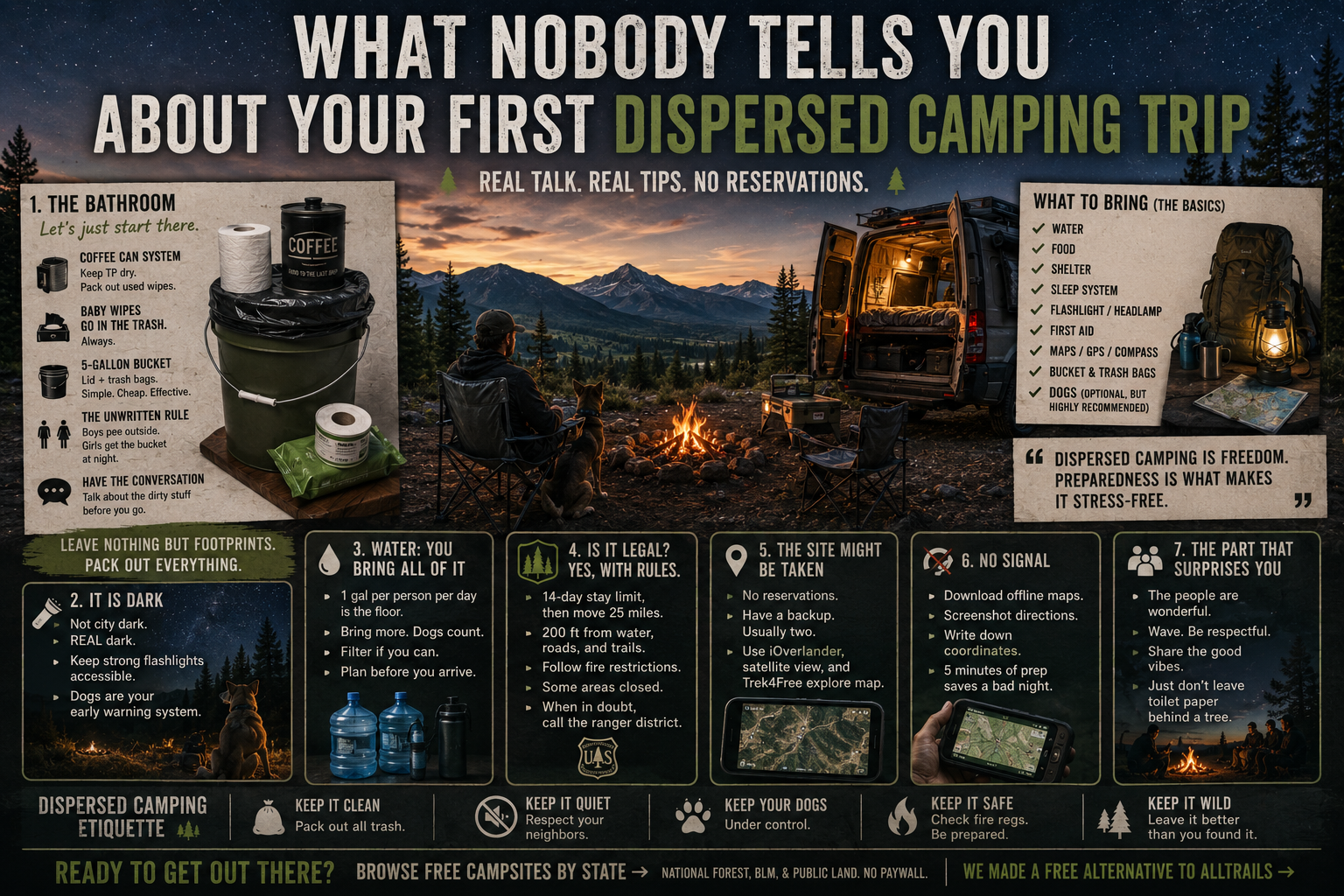
Dispersed sites have none of that. You bring your own water. You handle your own waste — there’s an honest guide to that here. The site is wherever you can legally and responsibly set up, not a numbered post with a gravel pad.
What dispersed camping also has: no neighbors unless you want them. No generator noise at 11pm. No camp host walking by at checkout time. Stars that go edge to edge without a light post in the frame. The forest in the morning before anyone else is moving.
I’ll take the tradeoff every time.
The Taxes Argument
Here’s the thing that actually frustrates me: the dispersed camping option has existed all along. The same agency — USDA Forest Service, Bureau of Land Management — that charges fees for developed sites also manages hundreds of millions of acres where you can camp for free. It’s the same agency. The same public land. The free option was always there.
The Recreation.gov booking fee didn’t create the frustration. It crystallized it. When you’re clicking through a reservation flow and you see a $10 nonrefundable charge on top of the nightly rate on top of the entry fee, you start doing the math. And the math leads you here.
You already own this land. The question is which part of it you want to camp on.
Finding the Free Sites
The hard part used to be knowing where to look. Government websites are not built for trip planning. They’re built for compliance. Finding a dispersed campsite used to mean downloading a forest service motor vehicle use map, cross-referencing it with satellite imagery, calling the ranger district to confirm access, and hoping the road wasn’t washed out.
That’s what Trek4Free is for. We’ve aggregated dispersed camping locations on national forest and BLM land across all 50 states into one searchable map — no paywall, no login, no booking fee.
Browse free campsites by state →
Every listing links to a full location page with a map, weather forecast, and nearby outdoor spots within 8 miles — trails, swimming holes, hot springs, local events. Things to do while you’re there. Not just a pin on a map.
A Note on the America the Beautiful Pass
If you’re going to spend any significant time in national parks or on federal recreation sites, the $80 annual America the Beautiful pass is the right move. It covers entry to national parks, national forests, BLM sites, and other federal lands for one year. At $35 per vehicle entry fee, that’s paid off in three visits.
It does not cover the Recreation.gov transaction fee. Nothing covers that except not using Recreation.gov — which is to say, camping on the free land that was always available.
We built Trek4Free specifically for this: finding the public land that’s open, free, and worth camping on. Browse free camping by state →. Or read more about why we built it: we made a free alternative to AllTrails →