
You're Never Lost. You're Just Discovering New Places.
You’re Never Lost. You’re Just Discovering New Places.
We left Colonial Heights on a Friday afternoon after work. Mountains were the destination — no specific plan, just the general direction of west and the assumption that we’d figure it out.
Here is the first thing you need to know: I fall asleep at the wheel in under twenty minutes. It’s a known issue. Amy was navigating. This is our weakest crew combination.
”It’s Thinking”
It was getting dark. I had maybe a mile before a significant intersection, and I needed a decision. Left or right. I asked.
No answer.
I asked again.
Nothing. Just Amy, in a low steady breath, almost like a chant: “It’s thinking. It’s thinking.”
I hit the intersection. No decision had been made. I grabbed the phone to check myself — and I couldn’t read the words on the screen. Not a vision problem. A language problem. The map was in French.
I zoomed out. Amy had somehow navigated us near Paris, France. Google Maps was doing its best to route us to the French capital from the Virginia Piedmont, and it had been “thinking” about it for the last twenty minutes while I asked repeatedly for a turn.
I made a decision at random, drove until I found a dark spot in the national forest, and we went to sleep.
The Run
We woke up not entirely sure where we were.
The correct response to this situation, obviously, is to go for a run.
We started working uphill through the trees. The forest was quiet and still and completely unmarked. After a while we started passing small cabins — the kind that don’t belong on a national forest road, set back in the trees, clearly maintained. Unusual. We kept going.
The trail led us into a larger compound. A more substantial structure. A cleared area with the feel of intention behind it.
That’s when we ran into the interpreters.
First Guests
Two park rangers were moving around the site, setting things up — adjusting displays, organizing materials, getting ready for something. They looked up when we came out of the trees.
The site was not yet open to the public. They were preparing for its first visitors.
We were the first visitors.
They were more excited to see us than we were to see them. They had been waiting for someone to share this place with, and instead of waiting longer, a couple of trail runners had materialized out of the woods on a Saturday morning looking confused.
They invited us in.
What We Had Stumbled Into
Rapidan Camp — also called Camp Hoover — was Herbert Hoover’s summer White House, built in 1929 on the Rapidan River in the Blue Ridge Mountains.
Hoover was an avid fly fisherman. He wanted a retreat within a reasonable drive of Washington where he could fish a cold mountain trout stream and escape the heat. He found the Rapidan River in what is now Shenandoah National Park, built the camp himself (funded privately, not by the government), and used it as his primary summer retreat for the duration of his presidency.
When he left office in 1933, he donated the camp and the surrounding land to the federal government.
The next president — Franklin Roosevelt — was in a wheelchair. The Blue Ridge terrain was inaccessible to him. He couldn’t use the camp. Instead, he used federal funds to build a new presidential retreat in the gentler Maryland mountains: a place he called Shangri-La. Eisenhower later renamed it Camp David, after his grandson.
So Hoover built his own retreat with his own money, gave it away, and his successor couldn’t use it, built a replacement with government funds, and that’s the camp we all know. Hoover’s original — the one that started it — sits quiet in the Virginia mountains, largely forgotten.
The small cabins we had passed first, set back in the trees? Those housed the Secret Service and the Marines who protected the President and his guests when the camp was in use.
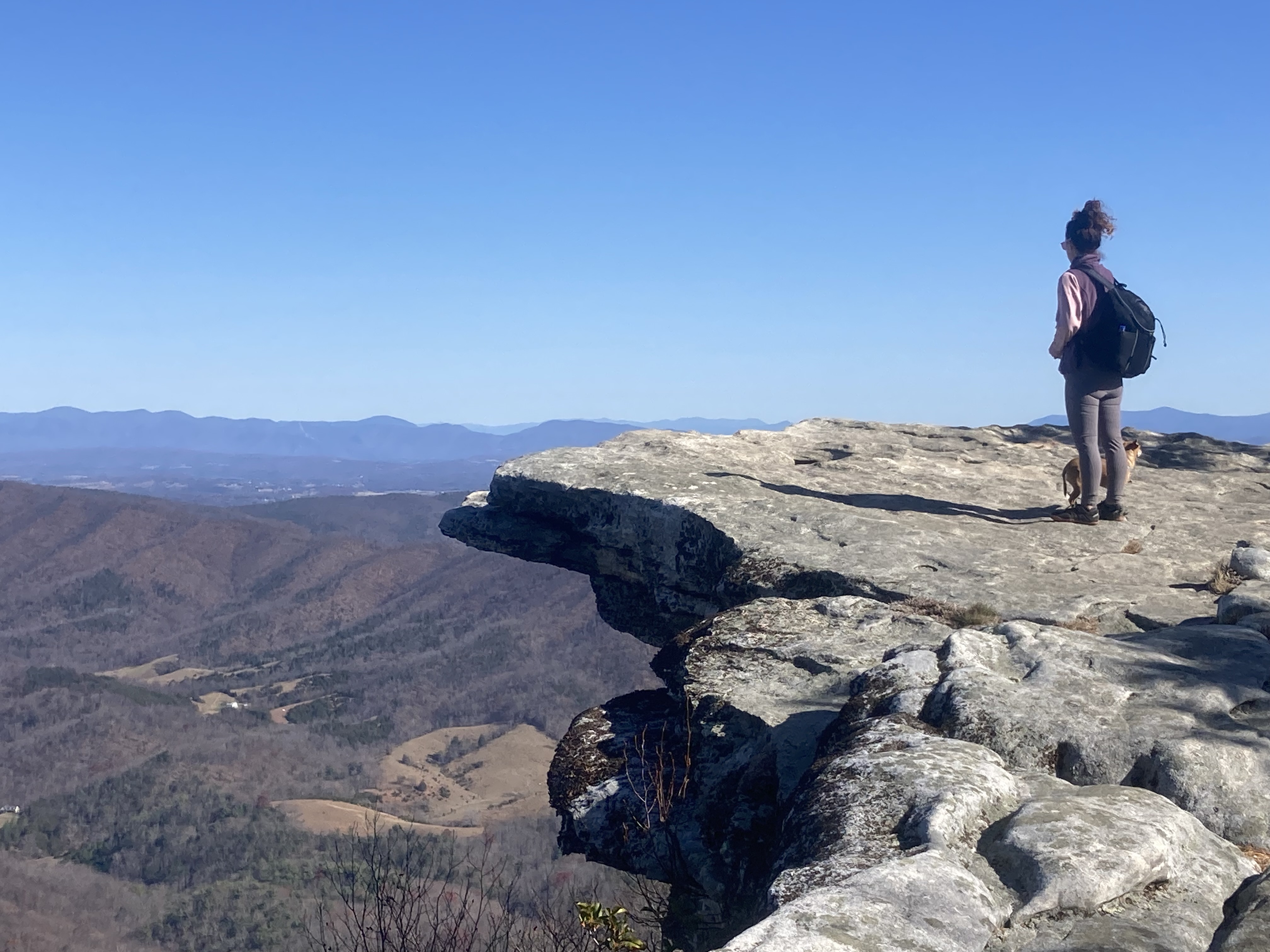
Lou Henry Hoover loved the Boy Scouts. During their summers at Rapidan, she would set up white canvas tents on a promontory overlooking the valley for Scouts to visit and camp — a deliberate, personal invitation from the First Lady. The view from that ridge is still there.
The Rapidan River still runs cold below the camp. Still holds trout. Hoover’s favorite stretch.
Getting Our Bearings
We thanked the interpreters, got back on the trail, and kept running uphill.
Eventually the forest thinned and the trees gave way to the open shoulder of the ridge. The Blue Ridge Parkway appeared in front of us. We stepped out onto the road, looked both ways, recognized where we were, and had our bearings for the first time since Amy had been navigating us toward France.
We turned around and ran back down through it all — past the trout stream, past the cabins, past the place where Lou Hoover had set up tents for kids who probably had no idea they were sleeping on a presidential mountain — and came out where we’d started.
The Moral
You are never lost. You are just discovering new places.
Every misdirected drive, every wrong turn, every intersection where no decision got made — these are not failures of navigation. They are invitations. The national forest road you took by accident has something at the end of it. The dark spot you found to sleep is three miles from something nobody visits anymore.
The plan would have taken us somewhere we expected. The detour took us somewhere we’ll never forget.
Rapidan Camp (Camp Hoover) is free to visit in Shenandoah National Park. The site is accessible via a 4-mile round-trip trail from Milam Gap on Skyline Drive — or, apparently, from below through the national forest on a Saturday morning when you meant to be somewhere else. Trek4Free’s explore map covers Shenandoah trailheads and free camping in George Washington National Forest.