
The SUV Camping Car: Not Pretty, But It Works
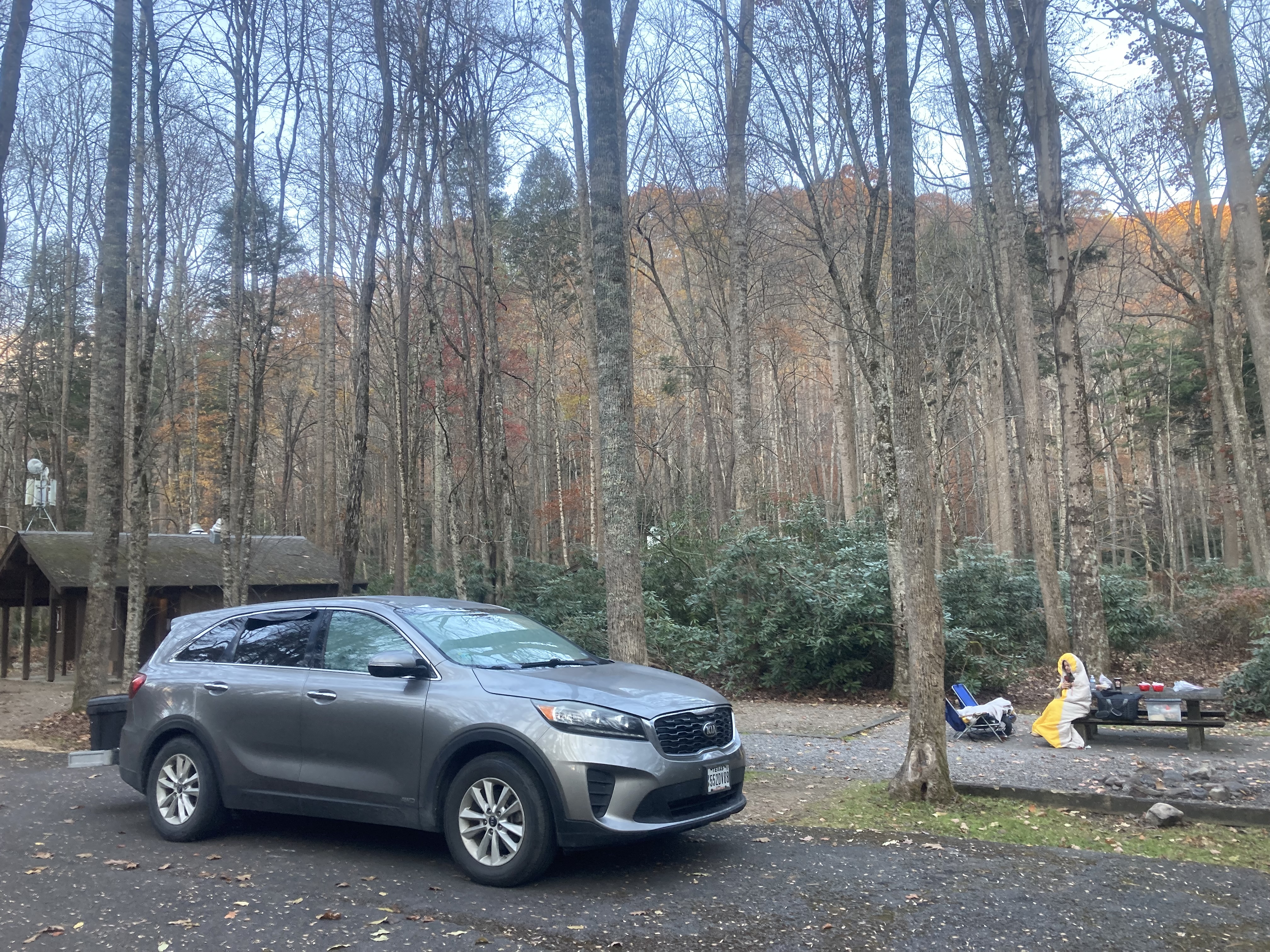
The SUV Camping Car: Not Pretty, But It Works
Let me tell you about the day our trailer tried to catch fire on the highway.
We were towing through the Texas heat — dogs in the car, gear in the trailer — when the transmission started running hot. Not “warm” hot. Hot enough that it pushed fluid out of the vent, onto the engine, where it met exhaust heat. We smelled it before we saw it. Pulled over on the shoulder of a busy highway, got out, opened the back of the car, and tried to safely get two large dogs out of the vehicle and away from traffic while trucks blew past at 75 mph.
That was the last time we towed a trailer for camping.
The Towing Math Nobody Posts About
Towing a camping trailer sounds practical on paper. It separates your living space from your daily driver. You hitch up when you want to go somewhere, unhitch at the campsite, drive around freely. Clean system.
Here’s what the YouTube videos don’t spend enough time on:
Fuel economy. A typical SUV getting 25 mpg on the highway will drop to 13–16 mpg with a loaded camping trailer. On a long trip, you’re burning nearly twice the fuel. The math adds up fast — a 1,000-mile trip that costs $80 in fuel now costs $160.
Transmission stress. Towing puts sustained load on a transmission that was designed for intermittent highway driving, not continuous high-torque pull at elevated temperatures. In flat states you can get away with it indefinitely. In Texas summer heat, on grades, it becomes a roulette game. Transmission coolers help. They are not optional if you’re towing regularly, and most people don’t add them until after they’ve had the problem.
The breakdown scenario. When a tow vehicle breaks down, you now have two immobilized objects instead of one. If it happens on a highway shoulder, you’re trying to manage traffic, a broken vehicle, and whatever is in the trailer simultaneously. If you have dogs, they’re part of that equation too.
Parking. Downtown Rockport. The parking lot at Goose Island State Park. The road to The Big Tree. Watch for 20 minutes and you will see an RV or trailer clip a live oak that’s been standing there for 200 years. Not because the drivers are careless — because the turning radius of a vehicle-plus-trailer requires a level of spatial awareness that doesn’t come naturally, and some spaces simply weren’t designed for them. The live oaks don’t recover from that.
The Expensive Solutions
Sprinter van, custom build: $80,000–$200,000 depending on the build quality. Stunning vehicles, purpose-built for the lifestyle, genuinely comfortable. For most people, financially impossible.
Class B motorhome: Similar price range. Same access and parking issues as larger rigs, just in a slightly smaller package.
Vintage VW van: Cool. Genuinely iconic. And a commitment to a mechanical relationship that will consume as much time and money as the vehicle itself. Parts are expensive, mechanics who know the platform are rare, and the engines were not designed for modern highway speeds or Texas summer temperatures. The people who make VW van life work usually have a mechanical background and treat maintenance as part of the hobby. If you just want to get outdoors, this may not be that.
The Middle Path
The SUV camping car doesn’t photograph as well as a Sprinter. It doesn’t have the soul of a VW van. It is not officially recommended by anyone, because modifying a daily driver introduces compromises that complicate everything from insurance claims to warranty coverage.
It works anyway.
An SUV with a quality sleeping platform, a 12V power system, and a cargo organization setup gives you:
- Real fuel economy. 22–28 mpg on the highway, same as you’d get commuting.
- Safety systems. Lane departure warnings. Forward collision alerts. Blind-spot monitoring. On a highway where the rush-rush-rush crowd is doing 85 and you’re just trying to get through safely, these systems are not luxury features. They are genuinely useful.
- Maneuverability. A standard SUV parks in standard parking spaces, navigates standard campground loops, and fits on the narrow roads through the live oak groves without taking anything down.
- Breakdown options. When your vehicle breaks down, you have one disabled object, not two. And here’s the exit strategy that keeps the stress manageable: in a real emergency, U-Haul has car dollies and trucks available in most mid-size towns. You can rent a truck, load your vehicle on the dolly, drive home, and figure the rest out from there. Knowing that option exists — even if you never use it — makes the whole thing feel less fragile.
The Non-Permanent Philosophy
The best mods for an SUV camping conversion are the ones that come out when you need them to. Fold-down sleeping platforms. Magnetic window coverings. Removable cargo organization systems. A Jackery or similar portable power station that sits in the back and comes inside when you’re not camping.
This is not the Instagram-ready build. It’s a functional system that lets you use your actual car for actual camping trips. The seat folds back down for the school run. The gear comes out for the hiking weekend. It’s a square peg in a round hole, but when the hole is “get outdoors without spending $150,000,” the square peg gets a lot of things done.
YouTube makes it look easy. It’s not easy. There are comfort trade-offs, heat management challenges, privacy issues, and the persistent background hum of “what if this breaks?” that doesn’t go away entirely no matter how much you plan.
But the transmission isn’t going to catch fire. The dogs can get in and out without highway traffic three feet away. And down the road to Goose Island, the live oaks are going to be fine.
Trek4Free’s explore map and free camping filter can help you find spots with room for an SUV — including dispersed sites on national forest roads where a standard-clearance vehicle does just fine.