
Mountain Lion Tracks, a Grouse, and the Worst Timing in Trail History
Mountain Lion Tracks, a Grouse, and the Worst Timing in Trail History
West Virginia backcountry, after a light snow. I was trail running with my wife Amy and Lacy, my German Shorthaired Pointer, on a trail I knew well — far enough from any paved road that the snow had come down undisturbed. No cell service. No other people. Just us and the quiet that follows fresh snow in the mountains.
Then I saw the tracks.
There Are No Mountain Lions Here
That’s what the locals say. That’s what the wildlife officials say. That’s what everyone says about West Virginia.
These tracks said otherwise.
Mountain lion tracks have a distinctive shape — round, large, no claw marks because cats retract their claws. These were in fresh snow, unhurried, following the same trail I was running. There was no other explanation that fit. I’ve spent enough time outdoors to know what I was looking at, and I knew that whatever made those tracks was bigger than me and had recently been exactly where I was standing.
I am in the fire department. I am not someone who panics easily. I remained calm.
Amy remained calm.
Lacy seemed unconcerned, which was either reassuring or alarming depending on how you interpret a bird dog’s situational awareness.
Proceeding on High Alert
We kept moving. There was no real alternative — we were far from the trailhead, there was no cell service, and turning around meant running back through the same stretch of trail the tracks had come from. Forward made as much sense as back, and standing still made no sense at all.
Every bush got a long look. Every shadow. Every sound. I was running with all of the focus and alertness I could generate, which was considerable, because we were genuinely in the backcountry with a large predator whose tracks were fresh in the snow.
This is the part of the story where I explain that I remained composed, kept my family safe through calm leadership, and returned to the trailhead with dignity intact.
That is not quite what happened.
The Grouse
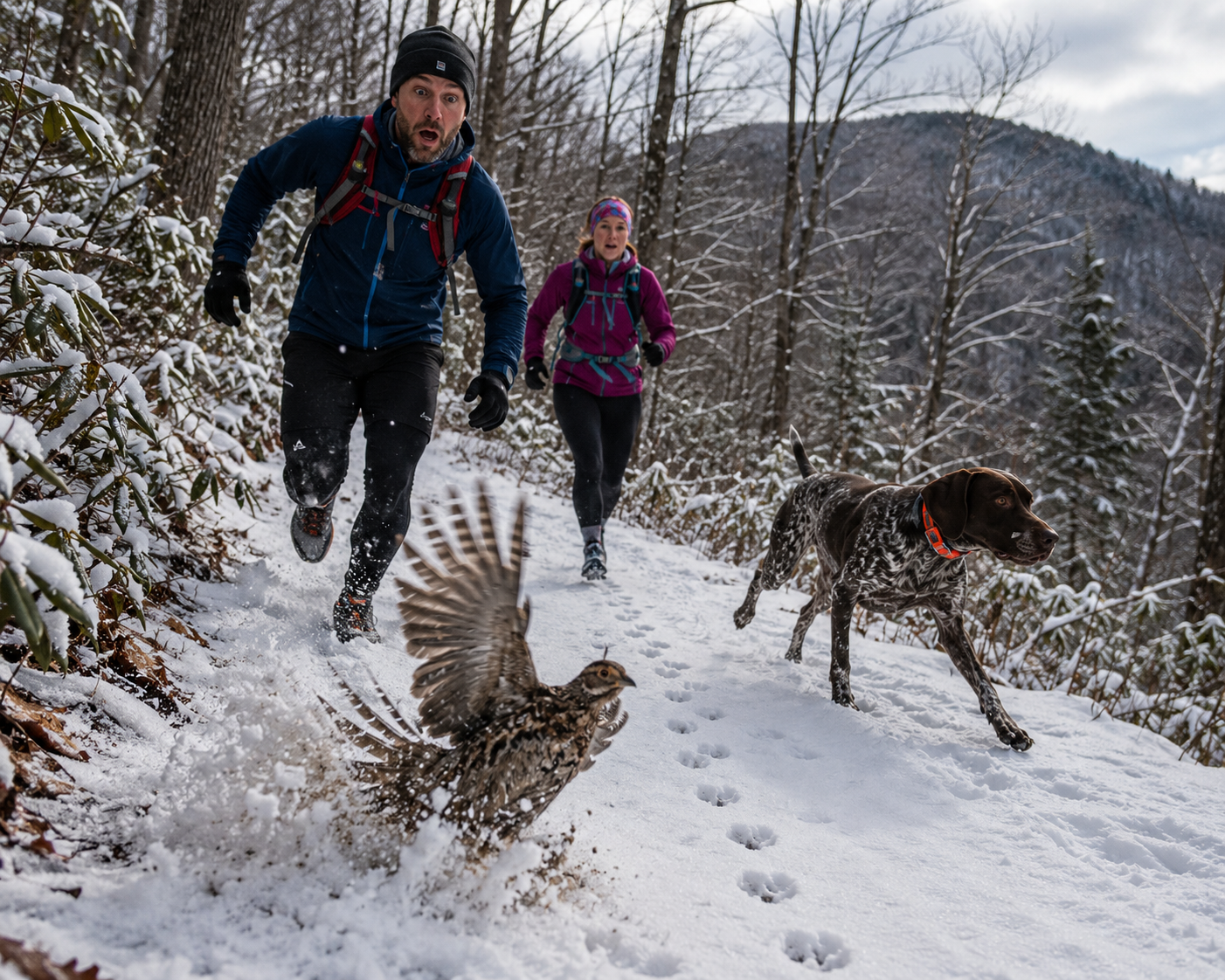
It launched from directly under my feet. Zero warning. A grouse goes from complete stillness to a full explosion of wings and noise in an instant — they are capable of startling animals that are actively looking for them, and I was not actively looking for a grouse. I was actively looking for a mountain lion.
The sound was immediate and enormous and came from exactly the direction I had not expected anything to come from.
My reaction was — how to put this — not the stoic, collected response of an experienced outdoorsman who had been mentally prepared for danger.
Lacy, my bird dog — a German Shorthaired Pointer, a breed literally developed over centuries for the specific purpose of finding and pointing at exactly this species of bird — ran right past it. Didn’t notice. Continued up the trail at her usual pace. The grouse she was genetically optimized to detect had launched from approximately six inches in front of her nose, and she registered nothing.
Amy, who had also been on high alert for the mountain lion, watched this unfold.
I may have lost some man-points.
What the Trail Actually Teaches
We got back to the trailhead without incident. Whatever made those tracks was somewhere else in the forest, which is where mountain lions — present or officially absent — tend to stay.
The grouse, after its dramatic exit, presumably landed somewhere and went back to being invisible.
What I take from that run: the trail will surprise you, but usually not in the way you’re expecting. You spend the whole run scanning for the mountain lion and the grouse launches from under your feet. You carry the tourniquet and you need it for a cut from a rock. You train for heat and the storm comes in cold.
Being prepared isn’t about predicting exactly what will happen. It’s about having enough capacity — physically, mentally, gear-wise — to handle whatever actually does. In that run, we had the fitness to keep moving, the sense to move forward, and no cell service to call for backup even if we’d wanted to.
The grouse was just free entertainment. I choose to frame it that way.
Lacy pointed birds for years on trails across the Appalachians and beyond. She got this one wrong and we still think about it.