Two Pairs of Running Shoes and the Dogs: My Complete Gear List
Two Pairs of Running Shoes and the Dogs: My Complete Gear List
Two pairs of running shoes. Layers. The dogs.
That’s close to the whole list. Add coffee and a chair and you have everything I need for a week in the backcountry.
I’ve been trail running and camping for over 40 years. I’ve done it on foot and in a van and out of a Kia Sorento. I’ve hiked 20-mile training days preparing for the Grand Canyon and I’ve wandered into backcountry West Virginia with nothing but a hydration pack and my bird dog. In all that time, the single most important thing I’ve learned about gear is this: the more of it you have, the less often you go.
The Problem with More
I’ve seen it at campgrounds and trailheads across the country. Someone pulls in with a truck full of gear — coolers, tents, tables, chairs, propane setups with multiple burners, lanterns, tarps, camp kitchens. They spend 90 minutes setting up. Another 30 breaking it all back down. The gear that was supposed to make camping comfortable has turned camping into a logistics operation.
I don’t say this with judgment. I’ve been there. I’ve owned more gear than I needed. I’ve bought things at REI that seemed essential in the store and sat in a closet for years.
The math is simple: more gear means more time packing, more things to organize, more potential for something to be wrong or missing or forgotten, more stress at the trailhead before you’ve even started moving. And if you’re stressed before you leave the parking lot, the joy goes out of it fast.
The way I see it: a simpler kit means I go more often. Going more often means more miles, more trail, more mornings in the woods, more swims in the cold creek. The gear is in service of the experience, not the other way around.
What Actually Goes With Me
Running shoes and layers is barely an exaggeration. Here’s what I actually bring:
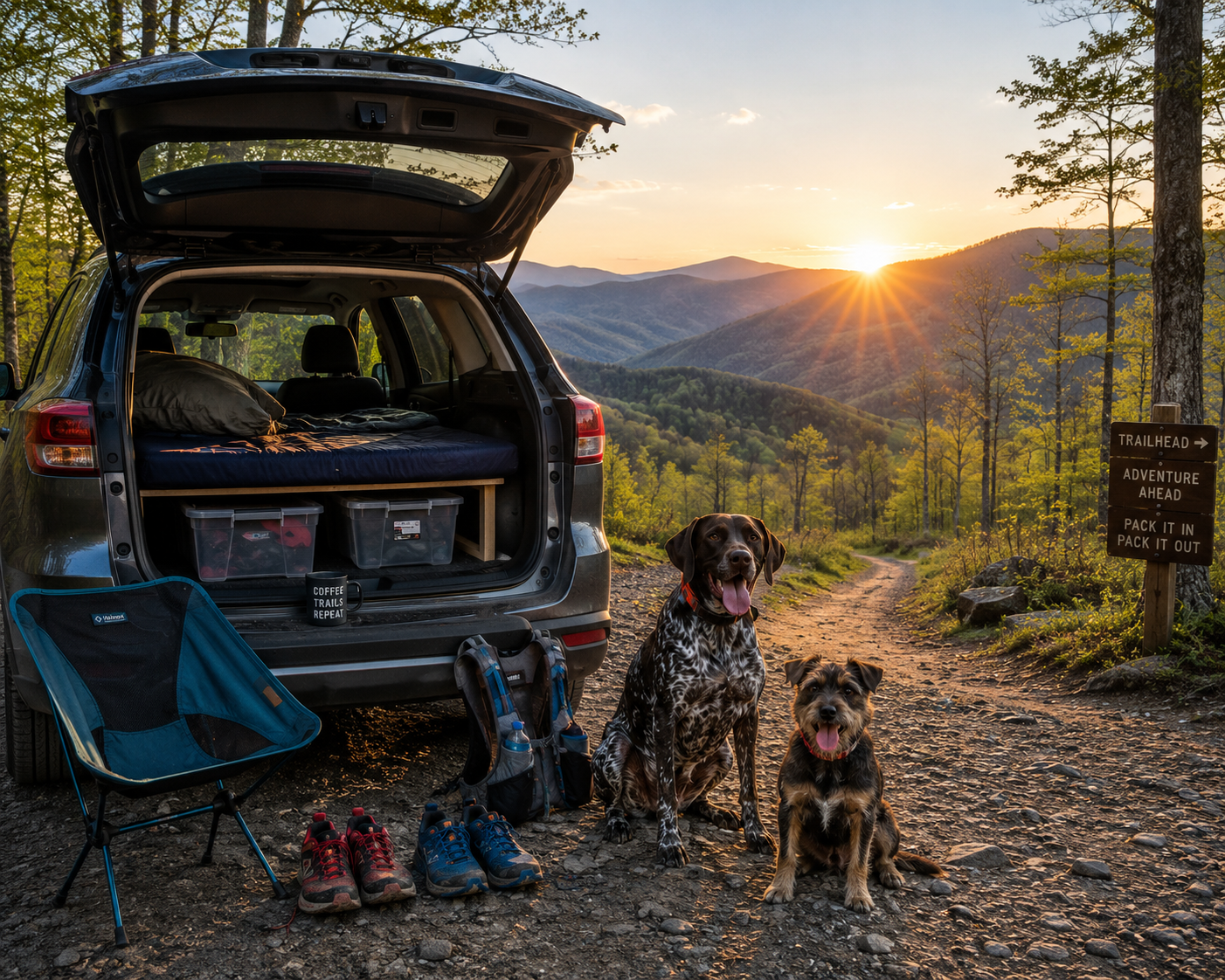
Footwear: Two pairs of trail shoes. One is the primary pair. One is the backup. That’s the most redundancy I carry.
Clothing: Moisture-wicking base layer, mid-layer fleece, wind/rain shell. All of it compresses small. All of it works in combination for most conditions I’ll encounter.
The kit: Headlamp, water filter, small first aid including a tourniquet and Israeli bandage. These are always on my body or in the pack — not in the car, not “nearby.” The pack is a Camelbak hydration vest. That’s it.
Camp: A sleeping platform in the cargo area of the car with organized Rubbermaid bins above it. Everything has a place. Everything packs in under 15 minutes. This matters, as we learned at Davis Mountains when a flash flood warning came in the middle of the night and we were driving out in under five minutes.
The chairs: These are non-negotiable. Not for trail running — for camp. When you get back from a 15-mile day and you want somewhere comfortable to sit that isn’t the inside of your car, a camp chair is civilization. It makes a campsite feel like a home. I’ll carry extra weight for the chairs.
The dogs: Not optional. Not gear, exactly — they’re trail partners and camp security and the reason I check every campground for dog-friendly policies before I book. They add complexity to travel and I’d have it no other way.
What Doesn’t Come
A tent. Most of the time. We sleep in the car — it’s faster to set up, faster to break down, keeps the dogs contained and comfortable, and when a ranger knocks at 2am because of a flash flood, you turn a key and go.
Multi-burner camp kitchens. One burner. One pot. Forty years, same setup.
The ultralight backpacking crowd has a philosophy they call “base weight” — the weight of everything in your pack before consumables. They obsess over it, shaving grams from every item. I respect that approach. Mine is different: I’m usually in a car, not a pack, so raw weight matters less than simplicity. I think of it as “ultra simple” rather than ultra light. Fewer items. Fewer decisions. Fewer reasons not to go.
The Point
I love mountain biking. I love rock climbing. I’ve done them for years and they’re incredible. But they require a different level of logistics — bike rack, gear bags, specific shoes, helmets. For a spontaneous Tuesday morning, that overhead changes the calculation.
Trail running and hiking has almost no overhead. Two shoes, a pack, a jacket, and you’re moving. The dogs are already excited. The coffee is in the thermos. The trailhead is 45 minutes away.
If the fun isn’t there before you leave, it’s hard to find it on the trail. Keep the setup simple and you keep the bar for going low. And a low bar for going outside is, after 40 years of mornings in the woods, exactly where I want it.
Trek4Free exists for the same reason: free access, no barriers, no complicated setup required. The map is there whenever you want to go.