
My Dog Got Me Home: Hiking with Dogs and the Gear That Always Goes With Us
My Dog Got Me Home: Hiking with Dogs and the Gear That Always Goes With Us
Hiking and camping with dogs is one of the purest joys in outdoor life. I want to say that clearly before I say anything else, because what follows is honest about how difficult it is — and I don’t want that honesty to read as complaint. I still prefer having them with me. Every time.
But it is genuinely difficult. A whole other category of difficult that doesn’t show up in the trail guides.
The Logistics Nobody Mentions
You can’t leave a dog in a car in Texas. Or in most of the South, or anywhere in the summer. The math on a hot car is brutal — temperatures can hit 120°F in under 20 minutes. Which means wherever you stop, they come with you, which means planning every meal, every errand, every resupply around what you can do with two dogs in tow.
Dog-friendly hotels exist, but as we’ve written before, the pet fees can run $75–$150 per night, per pet. That math stacks up fast when you’re on a multi-day trip. The practical answer is often the car — which is part of why we sleep in the car in the first place.
Then there are trails. Not every trail allows dogs. National parks are the worst for this — most trails in most national parks prohibit dogs entirely, or limit them to paved areas and campgrounds. State parks vary wildly, sometimes trail by trail. Campgrounds have their own rules. Before every trip, there’s a research layer that solo hikers and dog-free couples simply don’t have to do.
Add to that: water for the dogs on hot days, making sure they’re not overheating, watching for thorns and cactus in the paws in the desert, ticks after every hike, the fact that a small dog overheats faster than a large one, the social negotiation when other hikers or trail runners pass and the dogs react. It’s a lot.
And then one of them hears something outside the car at 2am and starts barking, and you realize they’ve been alerting to whatever is out there in the dark — a deer, a bear, another camper — and you’re grateful they’re there. They’re not just companions. They’re an early warning system that doesn’t sleep.
The Night Lacy Got Me Home
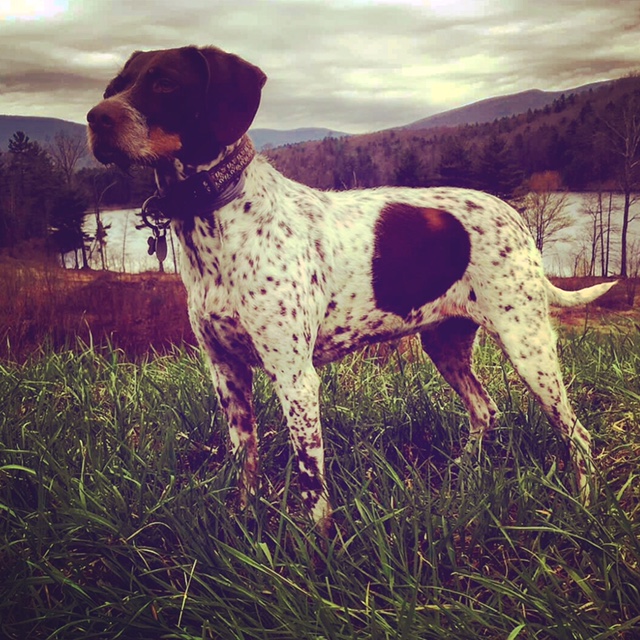
Before the chihuahuas, there was Lacy. A German Shorthaired Pointer — a trail runner’s dog, built for miles, made for exactly this kind of life.
I was running one of my favorite sections of the Appalachian Trail. Out and back, camping in my 4x4 Toyota van, just me and Lacy. The trail there looks like something out of the Sound of Music — open meadow, long views, the kind of place that makes you forget time. Which is exactly what happened.
I wasn’t planning to be out past dark. I didn’t have my headlamp.
It got dark.
Lacy was usually 50 yards ahead of me on the trail. That’s her natural pace — she runs ahead, checks back, runs ahead again. In the dark, 50 yards is nothing. She disappears completely. But she had a white rump, and in the darkness, that white patch was just visible enough that I could track her.
I asked her to stay close. She did.
We ran back to camp in the dark with me following a white patch of fur through the woods. I knew that trail — it was one of my regulars — but I was following her instincts more than my own memory. She knew the way. She stayed close. We made it back.
I’ve never gone out since without a headlamp. Not once. Not even for a short run. Not even on a trail I know perfectly. Because that night could have gone differently. A root, a wrong turn, an ankle — any of those and I’m on a familiar trail in the dark with no light and nobody who knows exactly where I am.
Three Things That Always Go With Me
That run with Lacy is one story. There are others.
I’ve cut my hand severely on a trail run. The kind of cut that doesn’t stop on its own. I had a first aid kit. I used it. It mattered.
I’ve been caught without water purification on a run that went longer than planned — we added miles because we had the time, but we didn’t add water for the extra distance. We had cramps. We had ten miles to go. The sun was setting. There’s a creek, there’s water, and without a way to treat it you have to make a choice between risky water and keeping going on fumes. That’s a real choice with consequences either way.
I’ve been on top of Pikes Peak when a mountain hailstorm came in fast. I’ve been on the AT in sudden rain. The mountains don’t care about your plans and they don’t give much warning.
From all of it, here’s what always goes with me now:
A headlamp. Not in the car. On my body or in the pack. Every single time. The Lacy run taught me that one. It weighs almost nothing and the single scenario where you need it is the scenario where you cannot improvise.
A water purification system. A Sawyer Squeeze or similar filter adds almost no weight and means that any creek, any puddle, any standing water becomes something you can safely drink. The cramps-with-ten-miles-to-go situation changes completely if you can treat water on the trail. It is not a scenario you can think your way out of through willpower.
A stop-the-bleed kit. A tourniquet. An Israeli bandage for compression. Basic wound care. The hand cut I mentioned was manageable. A worse fall in a more remote spot is not. Stopping the bleed is a skill and a kit — you need both. The skill is learnable in an afternoon. The kit fits in a small dry bag. These are not things you want to improvise in the field.
The Thing the ER Didn’t Tell Me
The hand cut I mentioned required stitches. The ER stitched it closed, and within a couple of days the wound was seriously infected — inflamed, draining, not healing.
An orthopedic surgeon removed most of the sutures. That’s a harder thing to watch than the original stitching. He explained that the wound needed to heal from the inside out — not sealed at the surface while bacteria worked underneath. He had me cleaning it daily with a 50/50 hydrogen peroxide solution.
He told me this technique came out of military surgery — field doctors noticed that wounds cleaned and left to drain before closure had dramatically lower infection rates than wounds closed immediately. The peroxide kills surface bacteria and keeps the wound bed clean while tissue rebuilds from the bottom.
The wound healed. It took longer than a stitched-and-sealed wound would have, but it healed clean.
I keep a small bottle of hydrogen peroxide in the car now. Every trip. It takes up almost no space and I’ve used it more times than I expected — a bad scrape, a deep thorn, and once for Lacy’s paw after she cut it on something on the trail. Mixed 50/50 with water, applied to the wound, let it bubble and clean. Same principle.
Field application: If you cut yourself out there and you can’t get to a hospital quickly, clean the wound thoroughly before you close it with anything. Water from your filter, hydrogen peroxide if you have it, whatever is available. A wound closed over dirt and bacteria is going to cause more problems than a wound left open and clean. Stop the bleeding, clean it, then close it.
What You Can Always Be Ready For
You cannot be comfortable in every situation. You cannot prevent mountain rain on Pikes Peak or a snap storm on the AT or a trail that takes longer than expected. You cannot always know what’s coming.
But there are three things you can always be ready for: darkness, dehydration, and bleeding. Those three scenarios have clear, lightweight, inexpensive solutions that fit in any pack.
Lacy is gone now. She was a great trail running partner. The white butt navigation system got me home on that dark AT trail, and I’ve thought about it on a lot of runs since. Dogs make everything harder and better simultaneously. That seems like a reasonable deal to me.
Trek4Free’s search page includes a dog-friendly filter for events — and the explore map covers free camping and dispersed sites where the dogs are always welcome.