
Pack Before You Sleep: A Flash Flood Story from Davis Mountains
Pack Before You Sleep: A Flash Flood Story from Davis Mountains
We were trail running and camping at Davis Mountains State Park in West Texas. No cell service. Clear enough when we turned in. We packed everything into the car before we went to sleep — the way we always do — and went to bed.
The ranger knocked in the middle of the night.
Not a friendly check-in knock. The kind of knock that gets you up immediately. Flash flood warning. Move to higher ground. Now.
We were driving out of that campsite in under five minutes. Everything was already in the car. We didn’t have to think. We just had to go.
What Was Coming
We had no idea what was happening in Kerrville.
Without cell service, we didn’t know that the same storm system moving toward us had already hit the Guadalupe River corridor. We didn’t know about the children’s camp. We didn’t know about the deaths. We found out later — the way you find out about things when you’ve been in a dead zone — and it hit differently than news usually hits, because we’d been in that storm system too, on the edge of it, and a ranger who was doing their job had come to our campsite in the dark to make sure we moved.
I’m in the fire department. Our people went to Kerrville to help with recovery. They didn’t come home the same. Nobody who worked that scene did.
I’m not writing this to compare our situation to theirs. There’s no comparison. We got a warning and we drove away. Others didn’t get that.
I’m writing this because the difference between us driving out and losing gear — or worse — was partly the ranger, and partly the fact that everything was already packed.
The System
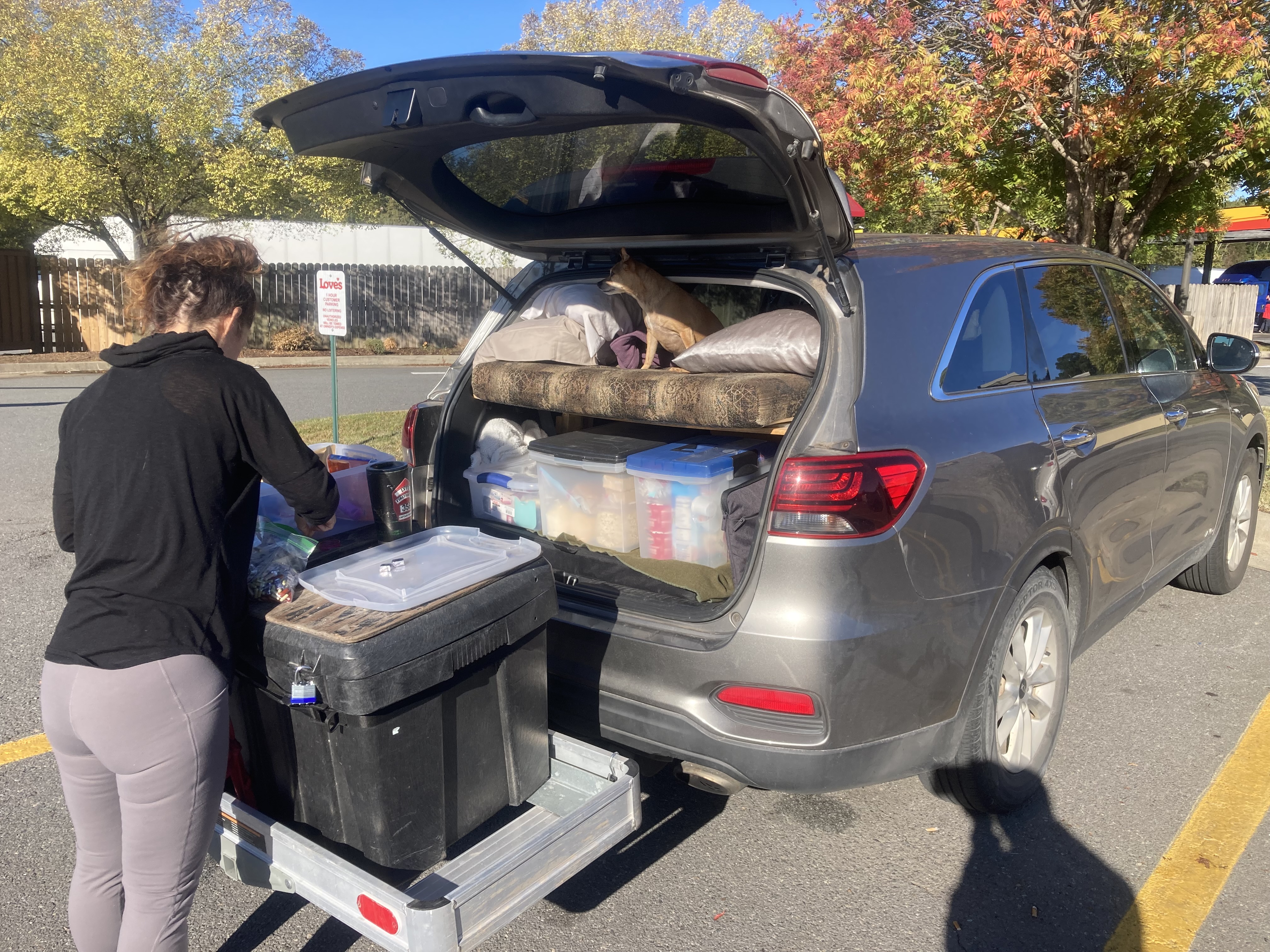
We sleep in the car. Not in a tent. The Kia Sorento has a flat sleeping platform in the cargo area, a plywood shelf above it that holds three Rubbermaid bins organized by category — food, cooking, gear. Camp chairs and the cooler ride on a hitch cargo carrier outside. The dogs sleep on the platform with us.
Before we close our eyes, everything that was out during the day is back in its place. The stove is secured. The bins are latched. The chairs are on the carrier. The car is ready to move.
This isn’t because we’re paranoid. It’s because it takes about ten minutes when you’re not rushing, and it means that if something happens — a weather change, a ranger knock, anything — you turn a key and you’re gone.
A tent is a different calculation. You’re looking at 20–30 minutes minimum to break camp in ideal conditions, more if it’s dark, more if it’s raining, more if you’re half asleep and something is wrong. There’s no “minimum viable” version of breaking down a tent. You either do it or you leave it behind.
What Happened to the Tent Campers
There were tent campers at Davis Mountains that night too.
Some of them lost equipment. When you have five minutes and your shelter is staked to the ground and your gear is scattered, the math doesn’t work. You grab what you can carry, you get in the car, and you leave the rest. For some people that meant tents, sleeping bags, cookware — everything they’d brought. Replaceable, in the end. But not nothing.
The ranger was doing his job. He didn’t have to come to each site individually, in the dark, to make sure people were moving. He did it anyway. That matters.
Why We’re Writing This
Trek4Free is built around the idea that the outdoors should be accessible — free camping, dispersed sites, no fees, no barriers. That’s still true. But accessible doesn’t mean carefree.
Flash floods in Texas don’t come with much warning. They happen in drainages far from where the rain falls. You can be in a dry campsite when a wall of water comes down a creek system that’s been draining a mountain range you can’t see. Davis Mountains, the Guadalupe River corridor, every low-lying campsite along a creek in Hill Country — these are beautiful places and they can become dangerous very quickly.
The things that help:
- Know where you are relative to drainages before you set up camp. Look at the terrain.
- Car camping or any camping-in-vehicle setup means you’re already halfway to gone.
- Pack before you sleep. Every time. It takes ten minutes and it’s the kind of habit that only matters once, when it really does.
- Know whether you have cell service. If you don’t, you’re operating without weather alerts.
- Trust park rangers. They’re not coming to your campsite at 2am because they feel like it.
We drove out of Davis Mountains that night and found higher ground and went back to sleep. We found out about Kerrville the next day. We thought about that ranger for a long time after.
Pack before you sleep. Every time.
Trek4Free’s explore map includes dispersed camping and free camping on public land — filter by state and region. Check terrain before you set up near drainages.