The Grand Canyon Mystery Nobody Has Officially Explained
The Grand Canyon Mystery Nobody Has Officially Explained
A mathematical theorem works differently than a mystery. A thousand supporting examples don’t prove a theorem — one counterexample kills it. But a mystery works the other way: one unusual claim is easy to dismiss. Two unrelated sources pointing at the same thing gets harder. Four independent sources — none of them connected to each other, three of which predate the speculation they supposedly inspired — all pointing at the same half-mile of restricted canyon you can’t visit? That stops being dismissible.
Here are the four threads.
Thread One: The 1909 Newspaper
In April 1909, the Arizona Gazette — a legitimate regional newspaper, not a supermarket tabloid — ran a front-page story about an explorer named G.E. Kinkaid who claimed to have discovered a massive cave system carved into the walls of the Grand Canyon. Not a small cave. A network of passages containing mummies, hieroglyphic tablets, copper weapons, pottery, and a central idol described as resembling Buddha with a lotus flower. The story said a Professor S.A. Jordan of the Smithsonian Institution was leading a full excavation of the site.

The Smithsonian has been asked about this story for 117 years. Their answer has never changed: no record of G.E. Kinkaid, no record of Professor S.A. Jordan, no knowledge of any such expedition, no artifacts in their collection from any Grand Canyon cave.
The article was never retracted. The Smithsonian’s 1909 records are incomplete. Nobody has definitively proven the story fabricated. Nobody has found the cave.
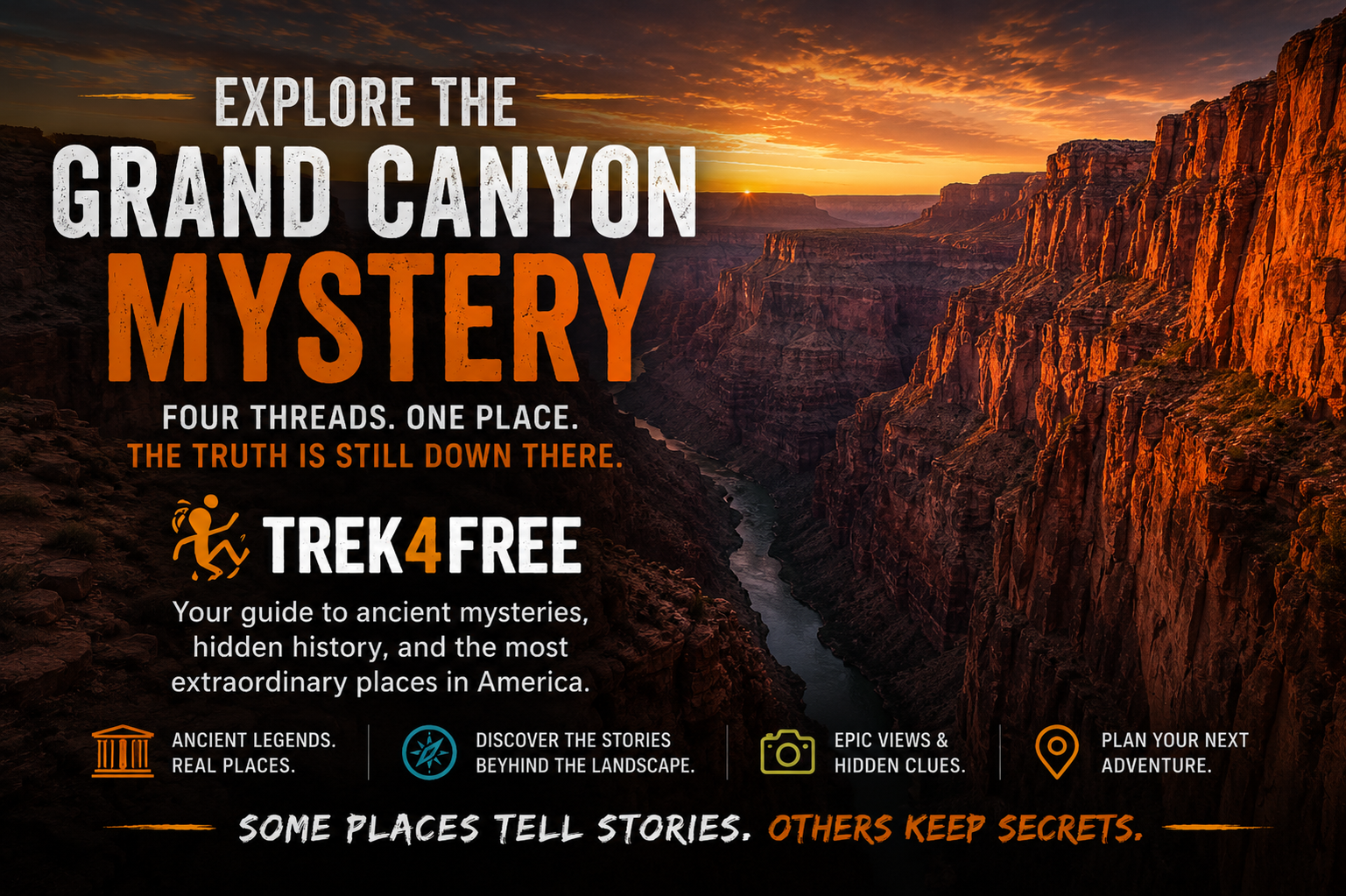
The location clue in the article — approximately 42 miles up the Colorado from El Tovar Crystal Canyon — places the site in the eastern Grand Canyon, near the confluence of the Colorado and Little Colorado rivers.
That location matters. Remember it.
Thread Two: The Maps
Pull up any NPS map of the Grand Canyon. Find the eastern and central section — the stretch of canyon that tourists don’t typically reach on day hikes, the part you’d need a multi-day river permit to access.
You’ll find: Isis Temple. Tower of Ra. Osiris Temple. Horus Temple. Cheops Pyramid. Tower of Set.

These are on official United States government maps. They have been since the 1880s — named by geologist Clarence Dutton decades before the Kinkaid article appeared. In the same stretch of canyon, Dutton also placed Hindu deity names: Shiva Temple, Brahma Temple, Vishnu Temple.
The standard explanation is that Dutton had a habit of giving exotic names to geological formations. That is technically true. It explains nothing about why this specific section of an Arizona canyon received the Egyptian pantheon. No other section of the Grand Canyon — or any other American canyon — received this treatment. The Egyptian-named formations are not scattered. They are clustered together, in the same general area as the Kinkaid location.
The names predate the 1909 article by thirty years. The convergence cannot be the result of one source inspiring the other.
Thread Three: The Calendar Builders
Before getting to what the Hopi say about the Grand Canyon, it is worth establishing what the Hopi and their ancestors demonstrably know how to do.
At Puerco Pueblo in Petrified Forest National Park — a 100-room ancestral Pueblo village abandoned around 1380 AD — a specific opening in the pueblo wall catches the rising sun on the summer solstice and projects a shaft of light onto petroglyphs carved into the interior. A spiral symbol is illuminated at solar noon. This is not interpretation or coincidence. It is an engineered astronomical calendar, built into the architecture of a village occupied for over a century. It works today exactly as it was designed to.

At Chaco Canyon, the massive great houses are precisely aligned to solar and lunar cycles — the major axis of Pueblo Bonito tracks the winter solstice sunrise. At Hovenweep, towers contain doorways and windows aligned to equinox and solstice sunrise points. The Sun Dagger at Fajada Butte — three stone slabs arranged so daggers of light bisect spiral petroglyphs at the solstices and equinoxes — functioned for roughly a thousand years before a rockfall disturbed the slabs in the 1980s.
The people who built solar observatories into cliff faces across the Four Corners region are the direct ancestors of the Hopi. This matters for what comes next. When the Hopi point at something and say this is where we came from, they are doing so as a people who paid precise, documented, architectural attention to the world around them for a thousand years.
Thread Four: The Hopi Sipapu
The Hopi call it the Sipapuni — the emergence point. In Hopi cosmology, this world is the Fourth World. The three before it were each destroyed, and in each case a remnant of the people survived by going underground and re-emerging into the next world when the time came.
The Sipapuni is the hole through which the Hopi people emerged from the Third World into this one.

The Hopi do not speak about this as metaphor or parable. This is active, living religion — as concrete and specific as any pilgrimage site in any tradition on Earth. And they have identified its physical location: near the confluence of the Colorado River and the Little Colorado River, in the eastern Grand Canyon.
The same stretch of canyon as the Kinkaid location. The same area as the Egyptian-named formations. The same corner of the Colorado Plateau where their ancestors built solar calendars into pueblo walls.
The Hopi were blocked from ceremonial access to the Sipapuni for decades — NPS restrictions combined with the broader suppression of indigenous religious practice through the late 19th and early 20th centuries. Access has been partially restored through government-to-government negotiations in recent years. This is not a historical footnote: a living people were denied access to what they consider their most sacred site for multiple generations.
There is a complication that Hopi scholars themselves have acknowledged: the transmission of ceremonial knowledge was interrupted during the period of forced assimilation. Some elders have noted that the precise site location may have drifted in the oral record during that gap. What is visited now may or may not be the exact original site. This is not a reason to dismiss the tradition — it is a reason to understand how much was damaged when the thread was deliberately broken.
The Access Problem

Large sections of the inner Grand Canyon gorge have no hiking trail, no legal river access without a multi-year-waitlist NPS permit, and restricted airspace above portions (a mix of Navajo Nation sovereignty, wilderness designations, and NPS park regulations). NPS rangers have documented turning back independent explorers attempting to reach unmarked cave openings visible in the canyon walls.
The restrictions fall on everyone equally — curious independent researchers and the Hopi people trying to reach their own sacred site are both told no. That parallel is the sharpest thing about this story. Whatever is in that section of canyon, the same rules that prevent an explorer from verifying the 1909 account also prevent the Hopi from completing a pilgrimage their tradition has been making for centuries.
What’s in there? Rock. Canyon. Possibly caves, as the Redwall limestone throughout the Grand Canyon is extensively hollowed by water — there are hundreds of known cave openings in the canyon walls, most unmapped, most inaccessible. Possibly nothing that would satisfy anyone looking for confirmation of anything.
But when you can’t look, the absence of evidence stops being evidence of absence.
What We Actually Know
The Arizona Gazette article was real, printed in a legitimate newspaper in 1909, and was never retracted. The Egyptian and Hindu place names are on official government maps and predate the Kinkaid story by thirty years. The Hopi emergence tradition places its origin at a specific physical location that independently converges with both other threads. The Hopi’s ancestors built verifiable, precise, durable solar observatories — they are not a people who mixed up directions. NPS access restrictions are real and apply to everyone.
What we don’t know: whether the 1909 article described a real discovery or a fabrication. Whether the name convergence is meaningful or coincidental. Whether what the Hopi visit now as the Sipapuni is the exact original site or a post-disruption approximation. Whether any of it connects.
Four threads. One stretch of canyon. A question you can’t go answer yourself.
That’s where we are.
The accessible pieces of this story are worth visiting on their own. The Hopi ancestral solar calendar at Puerco Pueblo in Petrified Forest is a half-mile walk off the main park road. The astronomical alignments at Chaco Canyon are the most ambitious engineering of the ancient Southwest. The mysterious towers of Hovenweep are practically deserted most days. All three appear on the Trek4Free Ancient Sites filter — and they tell a coherent story about a people who paid extraordinary attention to the world before anyone built a wall with a sign telling them not to.
For more of the underground side of this: our Caves guide covers 58 caves across 24 states including the Grand Canyon region.