American Caves: The Underground Side of Outdoor Adventure
American Caves: The Underground Side of Outdoor Adventure
Most outdoor adventure happens on top of the ground. Trails go up ridges, kayaks go down rivers, climbing routes go vertical on rock faces. The light is good. The views are obvious.
Caves go the other direction. They take you into the part of the landscape that’s invisible from above, into geology that took millions of years to build, into complete darkness that most people living in the modern world have never actually experienced. When a ranger in Mammoth Cave turns out the lights and lets the silence settle, you understand something about the world underground that no amount of description quite captures.
We’ve mapped 58 caves across 24 states on Trek4Free. Here’s what to know before you go down.
Limestone Caverns: The Classic Cave
Most American caves are limestone solution caves — formed when slightly acidic groundwater dissolves carbonate rock over millions of years, leaving behind passages, rooms, and the formations (stalactites, stalagmites, columns, flowstone) that most people picture when they hear the word “cave.”
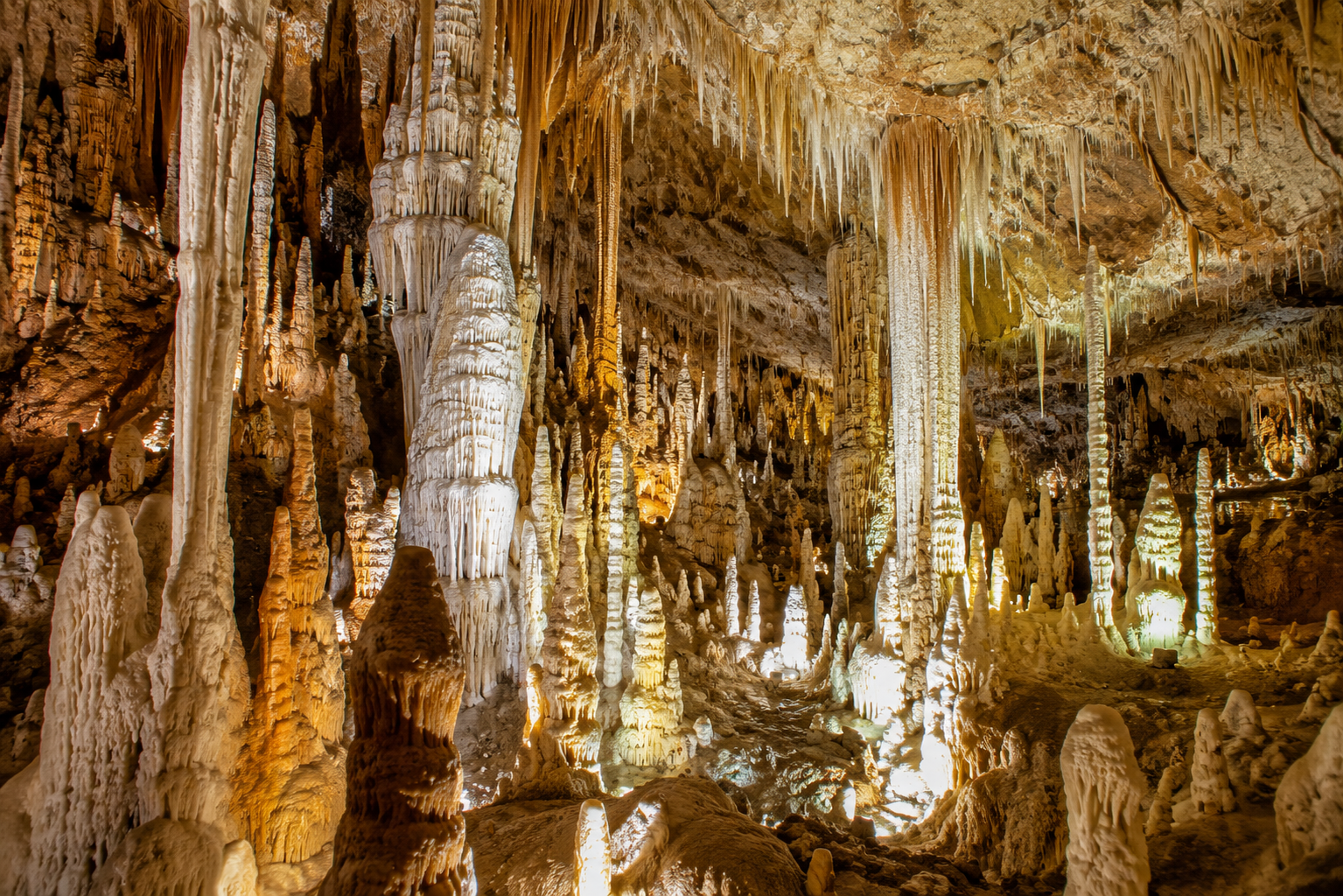
The big three NPS limestone caves are mandatory if you haven’t done them:
Carlsbad Caverns in New Mexico is the heavy hitter — 119 caves on one site, a Big Room large enough to swallow three football fields, and up to 400,000 Mexican free-tailed bats spiraling out at dusk from spring through fall. The bat flight alone is worth the drive to the Guadalupe Mountains. $15 adult, America the Beautiful pass accepted.
Mammoth Cave in Kentucky is the longest known cave system on Earth — over 420 miles of mapped passage. The human history layered into it is as compelling as the geology: saltpeter mining from the War of 1812, a tuberculosis hospital built underground in the 1840s, prehistoric fire pits left 4,000 years ago. When the ranger kills all the lights in a passage this deep underground, the darkness is a thing you feel, not just see. $14 adult.
Jewel Cave in the Black Hills of South Dakota is the third-longest cave in the world at 220+ miles — and explorers are still adding new miles every year. The calcite crystals coating every surface catch light like crushed glass. The Historic Lantern Tour by actual candlelight is one of the better cave experiences in the country. $14 adult.
In the Shenandoah Valley of Virginia, Luray Caverns is the most visited cave in the eastern US and earns it — rooms large enough to hold thousands, dramatic stalactites and columns, and the Stalacpipe Organ, an actual musical instrument connected to stalactites across 3.5 acres of cave. Every tour includes a performance. $32 adult.
The deepest single conversation I’ve had about caves was about Lehman Caves in Nevada’s Great Basin National Park — one of the most remote parks in the lower 48, which means you may have the cave nearly to yourself. Dense formations, rare shield speleothems, and the darkest skies in the contiguous US above ground. $15 adult for the cave tour; the park is free.
Lava Tubes: A Completely Different Kind of Cave
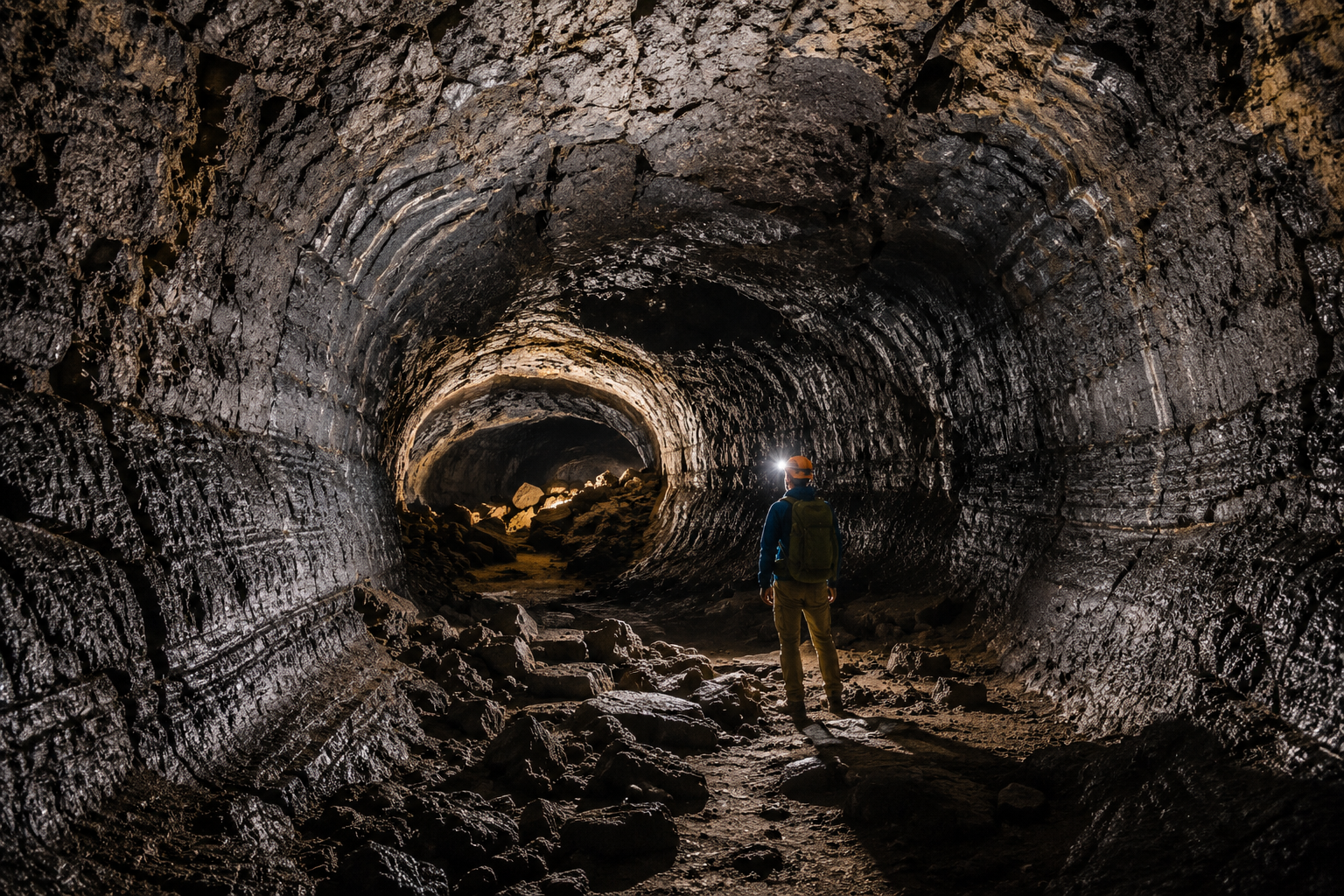
Lava tubes form fast — hours, not millions of years. A basalt flow develops a hardened exterior crust while molten rock keeps moving underneath, eventually drains out, and leaves a hollow tube. The resulting passages are smooth-walled, often cathedral-scale, and found primarily in volcanic regions of the West and Hawaii.
Ape Cave on the flank of Mount St. Helens in Washington is the one most serious outdoor people haven’t done yet and should. 2.5 miles of continuous passage, third-longest lava tube in the contiguous US, 42°F year-round. The lower section is an easy walk. The upper section — scrambling over a massive breakdown field of collapsed lava boulders in the dark — is something else entirely. No lights installed: bring three sources per person. Northwest Forest Pass required for parking ($5/day). The cave itself is free.
Lava Beds National Monument in northern California has 800+ lava tubes and lets you explore 25 of them with a flashlight you can borrow at the visitor center. The range from crawl-on-your-belly to 50-foot cathedral tunnels. It’s the best self-guided cave complex in the country for the price ($25/vehicle, covers everything).
Craters of the Moon in southern Idaho puts you inside the infrastructure of a volcanic system that could erupt again. Indian Tunnel has collapsed skylights flooding it with natural light. Boy Scout Cave requires crawling on hands and knees over permanent ice. The Great Rift zone last erupted 2,000 years ago. $20/vehicle.
In Hawaii: Thurston Lava Tube at Hawaii Volcanoes National Park is a 500-year-old tube approached through dense fern rainforest while the volcano it came from is still actively erupting nearby. Tree roots hang from the ceiling. $30/vehicle.
Free Caves on Public Land
Not every cave charges admission. Some of the best experiences in American caving are free.
El Malpais in western New Mexico has a chain of lava tubes on free public land, including Big Skylight Cave with collapsed sections that flood the tube with light. Some passages have permanent ice floors even in July. Free permit at the visitor center in Grants, NM. Bring three light sources.
Subway Cave in the Lassen National Forest in California is a 1,300-foot lava tube at 40°F with an interpretive brochure but no installed lighting. Completely free. Located right off CA-89 near Old Station.
Lava River Cave outside Bend, Oregon, is the longest uncollapsed lava tube in Oregon — over a mile — and free to enter. The cave narrows progressively as you walk deeper. A concession rents lanterns at the site for $5, or bring your own.
State Parks and Hidden Gems
Some of the most underrated American caves are in state parks, often with shorter tours, lower prices, and no national park crowds.
Kartchner Caverns in Arizona was kept secret by its discoverers for 14 years while they worked to ensure it would be protected. The result: a living cave with 99.4% humidity, stalactites with water still on their tips, and Kubla Khan — one of the tallest cave columns in the US at 58 feet. Book weeks in advance. $23 adult.
Florida Caverns State Park is the only cave in Florida with classic stalactite and stalagmite formations above the water table. Florida is not supposed to have a cave like this. It does. $2 adult for the cave tour plus park entry. Located in the Panhandle near Marianna — the most underrated cave in the South.
Lewis and Clark Caverns in Montana was the state’s first state park. Guided tours descend 300 feet through limestone chambers, exit from a lower portal, and look out over the Jefferson River canyon. Open mid-May through September. $12 adult.
Carter Caves State Resort Park in northeastern Kentucky has 26 known caves on 2,000 acres, including Cascade Cave with a 30-foot underground waterfall and an underground lake you tour by boat. Cabins and camping on site. Cave tours $9–14 adult.
The Weird and Specific
A few that don’t fit neat categories:
Penn’s Cave in central Pennsylvania is the only all-water cave tour in the United States — the entire 55-minute tour is conducted by flat-bottomed motorboat through flooded limestone passages where stalactites hang just above the waterline. You never leave the boat. Nothing else in American cave touring is quite like this. $22 adult.
Crystal Cave at Put-in-Bay is on South Bass Island in Lake Erie and requires a 25-minute ferry from the Ohio mainland to reach. The cave holds the largest known celestite crystals on Earth — strontium sulfate geodes up to 18 inches across, blue-gray and translucent, covering every surface. Discovered in 1897 when someone was digging a wine cellar. The winery is still above it. $8 adult.
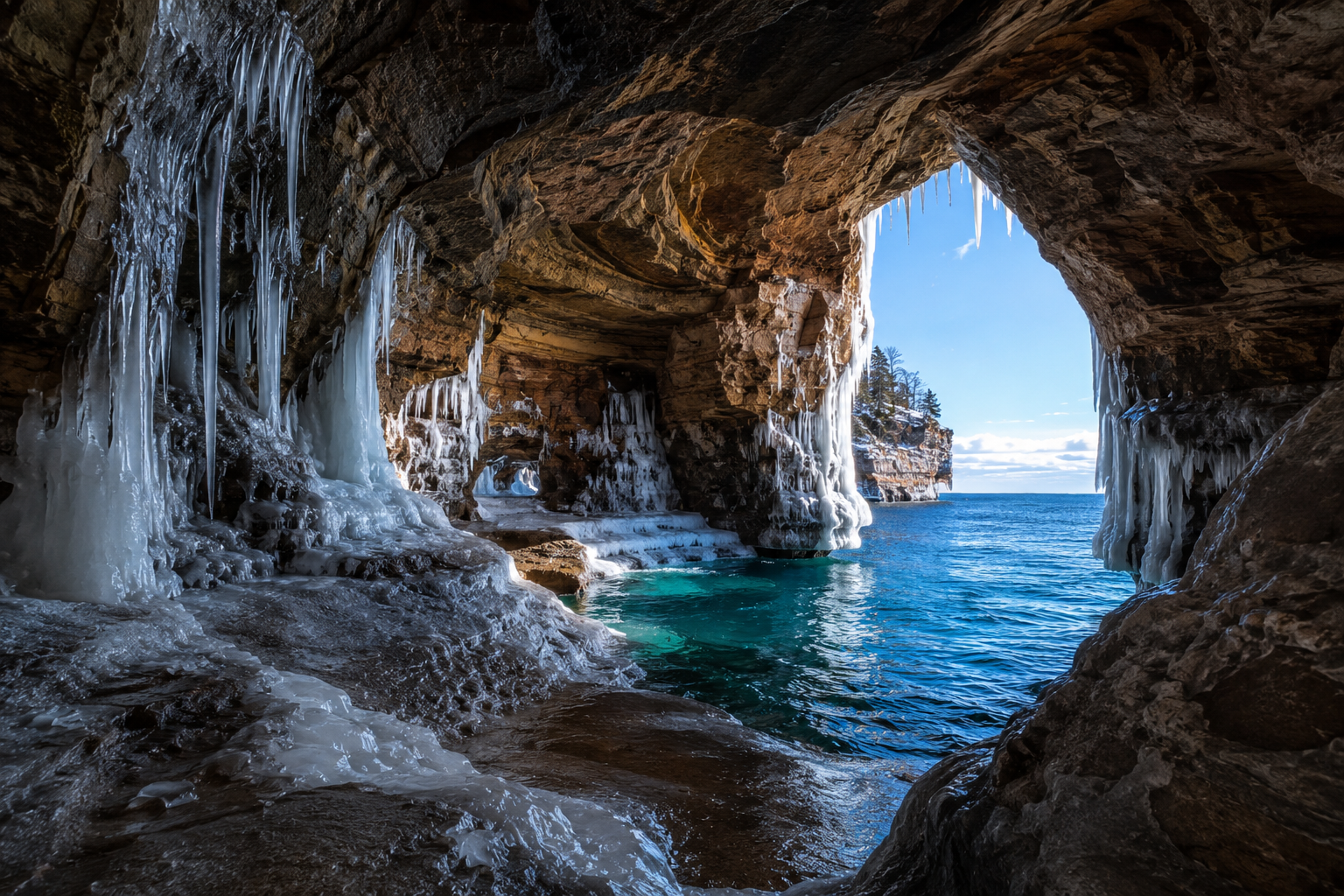
Apostle Islands Sea Caves in Wisconsin are sandstone caves carved by Lake Superior waves — accessible by kayak in summer when conditions allow, or on foot when the lake freezes solidly enough to walk out (not every winter). In ice years, frozen waterfalls and chandelier icicles inside the caves backlit by deep blue Superior water. $20/vehicle, no additional cave fee.
Grand Canyon Caverns on Route 66 near Peach Springs, Arizona, is a completely dry limestone cave 210 feet underground with a Cold War fallout shelter stocked from 1962 still visible in the main room. You can book a night in the underground hotel suite — no cell service, no outside light, 56°F. A genuine Route 66 original. $20 adult for the tour.
What to Bring
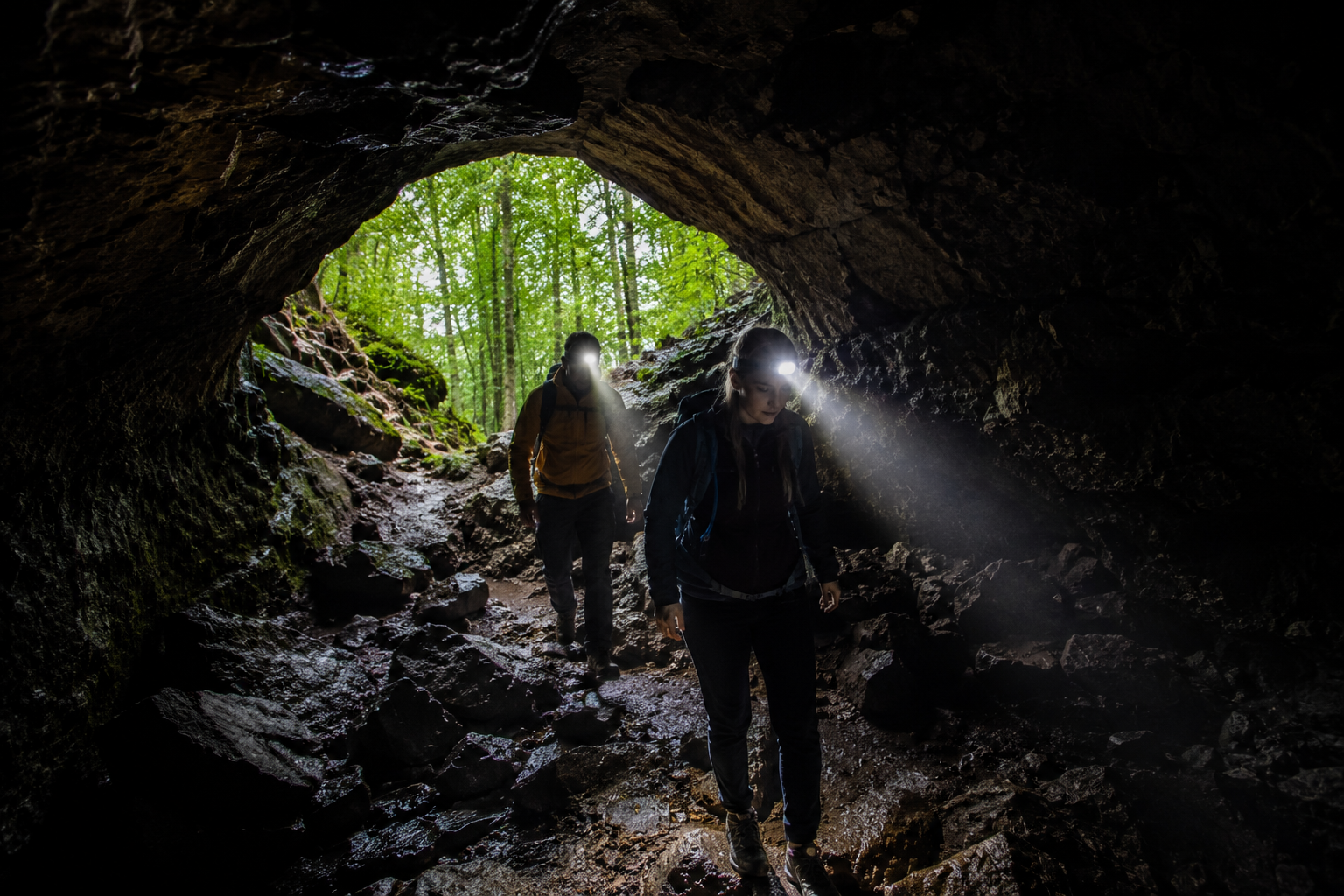
Most commercial show caves provide everything — tours are guided, lighting is installed, temperature is 52–58°F. Bring a layer you can tie around your waist.
For wild and self-guided caves, three light sources per person is the standard. Not two, not a phone flashlight and a backup — three independent sources. Cave darkness is total. Knee pads and gloves for crawling sections. Sturdy footwear with ankle support. Tell someone where you’re going.
Find all 58 caves on the Trek4Free map: Explore → Caves filter
Know a cave worth adding? Submit it here. We keep every entry free and ad-free.